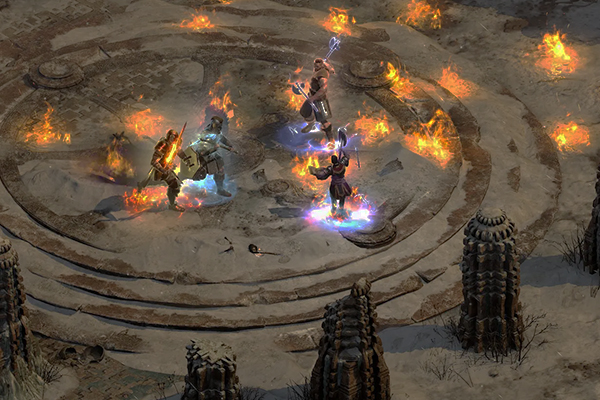
 Colossal Ancients is the new pinnacle endgame content in Diablo 2 Resurrected: Reign of the Warlock. Think of it as an Uber++ test that drops a Colossal Jewel that depends on which Ancient you defeat last. The fight is built around momentum: once you start, the encounter ramps up as you take Ancients down, so mistakes get punished harder the longer you stay inside. It also ties directly into Terror Zones, so it gives you a reason to keep running Terrorized Act bosses even after your character is already geared. If you like D2R endgame content that is fun and repeatable, learnable, and worth optimizing, this is the one.
The creator of this content is not affiliated with Mulefactory.
The best mindset is to treat it like a controlled gauntlet. You have to keep the arena stable, keep your buffs up, and manage risk as the fight escalates. This guide covers how to unlock, what happens during the fight, and how to prepare against the Colossal Ancients.
How to unlock the fight
You unlock Colossal Ancients through Terror Zones on Hell difficulty. At the end of a Terror Zone run, when you kill a Terrorized Act boss, there is a chance for a statue to drop. You need one of each of the five statues. Once you have all five, put them together in the Horadric Cube and transmute. That consumes the statues and opens access to the Colossal Ancients Uber.
The practical part is routing. Since statues come from Terrorized Act bosses, you should prioritize Terror Zones that end with an Act boss you can kill quickly and safely. If you are trying to collect all five, rotate between different Terrorized bosses instead of farming the same one for hours. Your time is better spent keeping the loop moving so you get more chances per hour. Once you have collected all the statues, craft the full set and run the fight. Make sure you are prepared both in terms of gear and mentally, because it is a real challenge.
What happens inside and how the fight works
The core mechanic is escalation. As you fight, the remaining Ancients grow stronger, and the intensity ramps up after each kill. That changes the pacing. Early on, you can play more aggressively. Late in the encounter, you must play smarter, because burst windows become more dangerous and recovery becomes harder if you misstep. This also means kill order matters. You are deciding which Ancient becomes the final “powered up” version, and you are deciding which threats you want to deal with when the fight is at its hardest.
The safe approach is to avoid messy splits. If you kite one Ancient far away while the others roam, you create crossfire, stacked auras, and sudden burst spikes. Instead, aim for controlled spacing: keep targets in view, keep yourself near an escape line, and avoid cornering yourself. If you rely on sustained damage, keep uptime steady. If you rely on burst, wait for clean openings instead of forcing it through bad ground or dangerous modifiers.
Kill order strategy and simple decision rules
Because the reward depends on which Ancient dies last, you have two reasons to plan the kill order: survivability and loot targeting. For survivability, pick the Ancient that your build handles worst as your first or second kill, so you do not fight that threat at maximum escalation. For loot targeting, plan the last kill around the jewel you want, then practice the same order repeatedly until it is consistent.
A simple method that works for most builds is this: identify the Ancient that creates the most arena chaos for you, then remove it early. Chaos can mean heavy ranged pressure, constant repositioning, or anything that prevents you from maintaining your damage pattern. If you are a melee build, remove the one that forces you to disengage the most. If you are a caster, remove the one that punishes stationary casting the most. The last kill should be the one your build can handle cleanly even when everything ramps up. Once you settle on an order, do not improvise every run. Consistency is the key.
Preparation checklist
You do not need perfect gear, but you do need a solid plan and at least mid-tier gear. Cap your resistances for Hell, and do not enter with a glass setup. The Uber gets harder over time, so survivability stats that prevent sudden deaths are worth more than small damage gains. Bring enough full rejuvs to cover a bad sequence, and keep your belt stocked so you do not lose the run to a logistics mistake. If your build benefits from Battle Orders, refresh it before the pull and again if you get a safe reset moment mid-fight.
Mobility is the single best quality of life tool. Teleport lets you reset angles, break a bad surround, and reposition away from stacked threats. If you do not have teleport, you can still win, but you must play the arena more carefully and avoid drifting into corners. For melee, add damage reduction and sustain so you can stay on target without panic disengages. For casters, prioritize cast speed and mana stability so you can keep your pattern running under pressure.
Rewards and how to farm them efficiently
The main reward is a Unique Jewel, and which D2R jewel you get depends on which Colossal Ancient you kill last. There are two jewel variants per Ancient, and the jewels have a level requirement of 75. There is also a major equip rule: you can only equip one of these Unique Jewels at a time, across your entire character, similar to how some unique charms are limited. You can still store multiple jewels in your inventory or stash, but you cannot stack their effects by equipping several.
Efficient farming is mostly about controlling statue acquisition time and keeping the fight consistent. Farm statues when the Terror Zone rotation gives you fast boss access, then batch your Colossal Ancients runs when you have supplies and focus. Pick one jewel target and lock your kill order around it. If you keep changing targets, you will keep changing your strategy, and your success rate will drop. Your best “profit per hour” comes from a stable loop: statues during good TZ windows, then clean kills with the same order and the same routine.
Build fit overview
| Build | Strength in the fight | Main risk | Key focus |
|---|---|---|---|
| Fire Warlock | Safe ranged AoE and strong burst on stacked phases | Bad positioning and fire resistant pressure | Zone placement, repositioning, mana stability |
| Magic Warlock | Consistent damage while moving, good control patterns | Letting targets split and losing uptime | Keep clumps tight, reapply DoT, stay mobile |
| Cleave Warlock | High density damage and strong sustain through uptime | Getting surrounded during ramped phases | Damage reduction, leech uptime, clean angles |
Summary
Colossal Ancients is the new Diablo 2 Uber zone. It is a ramping fight that requires planning, consistency, and decent gear. Unlock it through Terrorized Act bosses, cube the five statues, then treat every run like a repeatable routine: pick a kill order, control the arena, and keep your pattern stable as the encounter escalates. If you want the safest learning path, start with a ranged build and prioritize mobility and resists. If you want the most consistent clears across different modifiers, Magic patterns work well because damage keeps ticking while you reposition. If you want the fastest kills once geared, Cleave can do it, but only if you respect the danger of the final ramped phase.
How it works
Sell to us
Sell your items with a few easy steps and get paid in MuleCredits immedately. Credits can be cashed out or spent in our shop.
More articles on this topic
- Colossal Ancients Difficulty Increase in D2R Season 14: What to Expect
- Diablo II: Resurrected Ladder Season 14 Patch 3.2 Summary
- Sunder Charm Farming After D2R Patch 3.2
- Terror Zone Changes in Diablo II: Resurrected Season 14
- Diablo 2 Resurrected Crafting Guide for Beginners
- D2R Socketing Guide: Larzuk Vs Cube Recipe And When To Use Each One
- D2R: RotW Season 13 Meta After One Month
- Magic Warlock Endgame Farming Guide
